



I. Industry Background
Industrial inkjet printing is shifting from advertising graphics to industrial manufacturing, spanning packaging, digital textiles, PCB, and other fields. The global industrial inkjet printer market is approximately USD 7.03 billion in 2025 and is projected to reach USD 7.46 billion in 2026. Inkjet is a non-contact fluid-jet process whose print quality depends heavily on ink-supply system pressure; an imbalance of nozzle meniscus pressure causes defects such as missing dots, ink leakage, and streaks. With the spread of single-pass high-speed printing and circulation printheads, the system pressure window has narrowed sharply, leaving an allowable pressure margin of only ±0.2–0.3 kPa, requiring hectopascal-level resolution that traditional pressure gauges can no longer satisfy, creating a strong demand for high-precision pressure transmitters.
II. Industry Pain Points
Pain Point 1: Undetected negative-pressure drift leads to lagging ink-leakage and missing-dot failures
The existing equipment is only fitted with a local visual mechanical vacuum gauge, with no electrical-signal output and no closed-loop automatic control. Conditions such as slight air-circuit leaks, valve failures, and ink-carriage displacement all cause negative-pressure deviation, yet the system cannot perceive them in real time. Faults are only discovered after finished products show ink-leakage or missing-dot defects, directly causing batch material scrap, and require shutdowns for deep printhead cleaning, incurring double losses in both material and labor.
Pain Point 2: Insufficient accuracy of general-purpose instruments prevents standardization of the negative-pressure process
The ink-printing process requires extremely low negative pressure (about -1.5 kPa), but large-range general-purpose instruments are mostly used on site; their absolute error far exceeds the allowable process fluctuation range, so the true negative-pressure fluctuation cannot be captured precisely. Negative-pressure calibration relies entirely on manual trial-and-error spraying, leading to long commissioning and material-change cycles, with process parameters that cannot be standardized or replicated, resulting in poor process consistency across the production line.
Pain Point 3: No early warning for filter clogging, easily causing permanent printhead damage
Pigment ink particle sedimentation and UV ink crystallization easily cause filter clogging; without real-time differential-pressure monitoring, the clogging process cannot be predicted. Continuously decaying ink-supply flow leads to ink-starved missing jets, causing printhead air intake and dry burning, resulting in irreversible damage. The traditional fixed-cycle cartridge replacement model suffers from the dual problems of consumable waste and equipment damage from untimely replacement.
Pain Point 4: No data traceability for pump pulsation makes streak faults hard to eradicate
Diaphragm pumps have inherent pulsation characteristics; once the paired dampers and proportional valves age and fail, pressure pulsation causes periodic horizontal streaks in finished products. Without continuous pressure-recording data, faults are easily misdiagnosed as printhead or electrical faults, blind parts replacement cannot solve the problem, and fault localization is difficult with high repair costs.
Pain Point 5: Media corrosion + pressure shock shorten sensor life and cause easy failure
Solvent ink, UV ink, and cleaning fluids corrode the wetted parts of ordinary sensors, causing zero-point drift and diaphragm failure; the instantaneous pressure shock of the equipment's positive-pressure cleaning further leads to sensor-diaphragm overload damage. Ordinary transmitters have poor corrosion and shock resistance, with a service life far shorter than the equipment itself, and frequent failures compromise production stability.
III. Product Recommendation: GPT200 Piezoresistive Pressure Transmitter
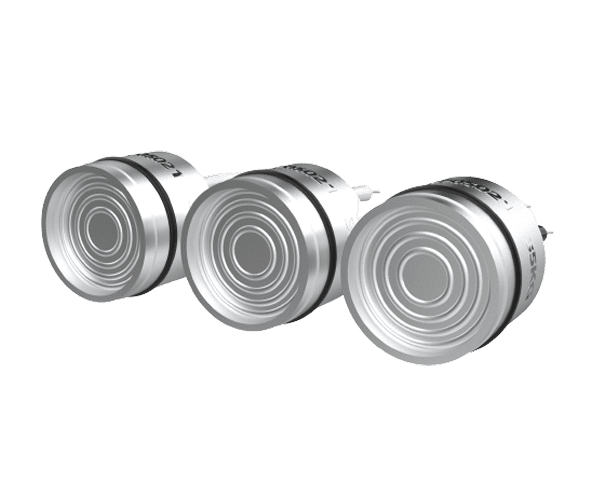
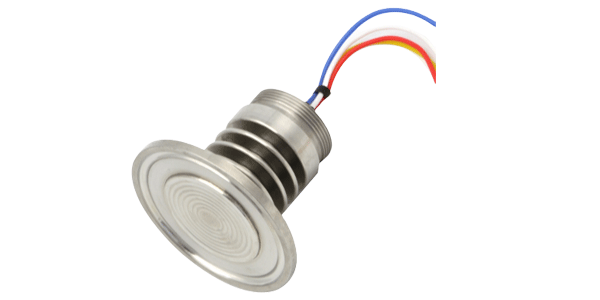
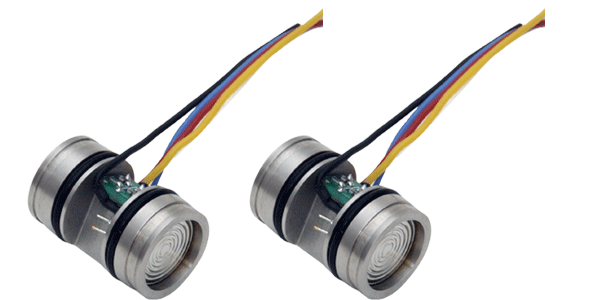
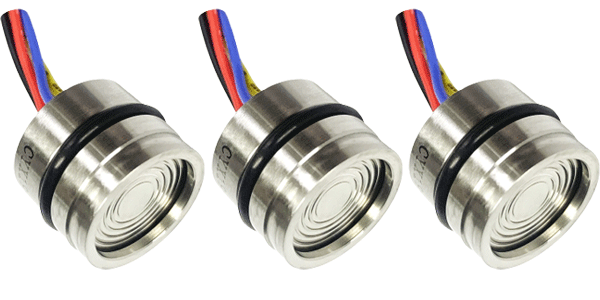
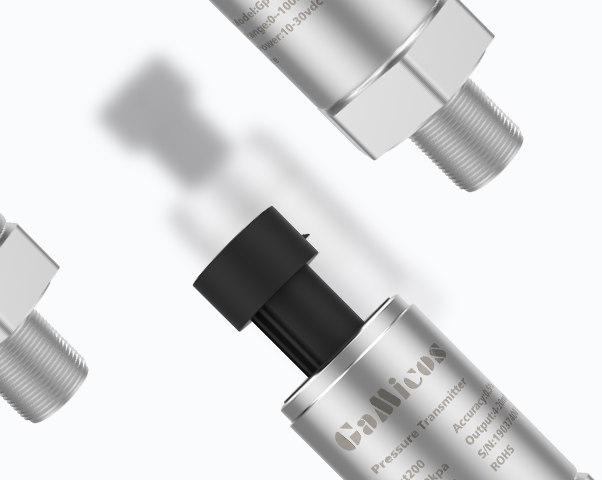
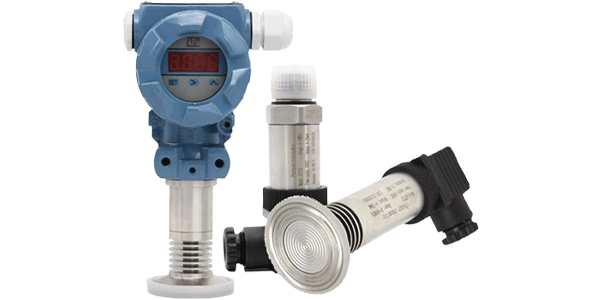
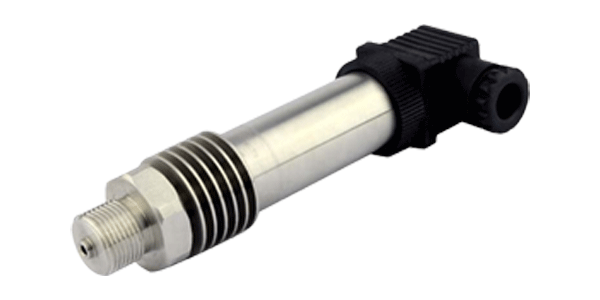
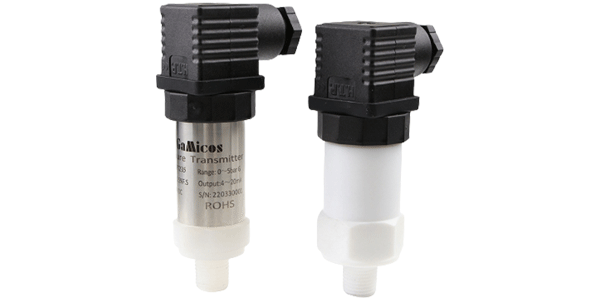
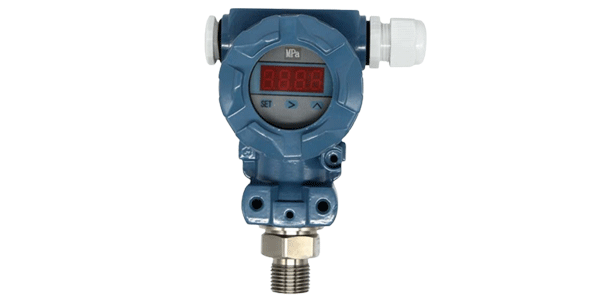
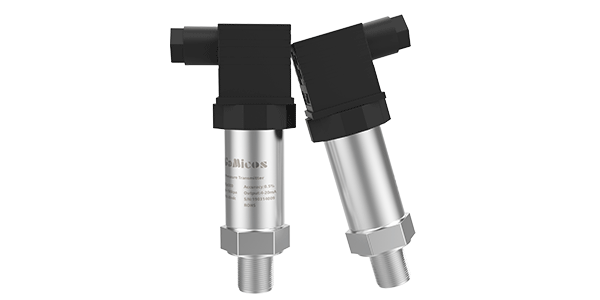
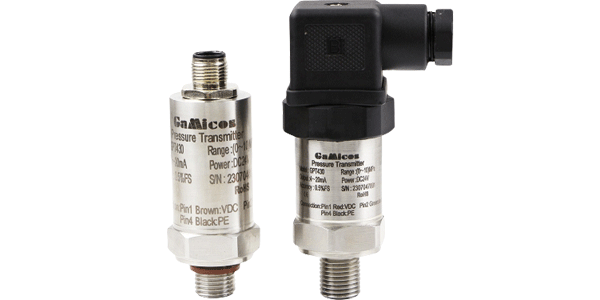
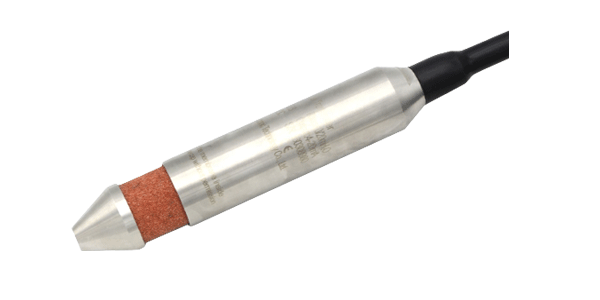
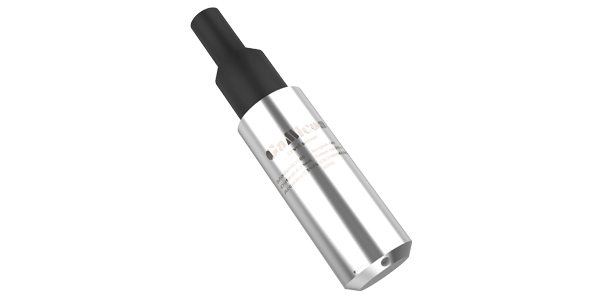
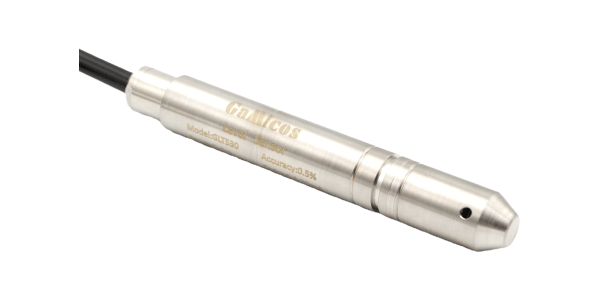
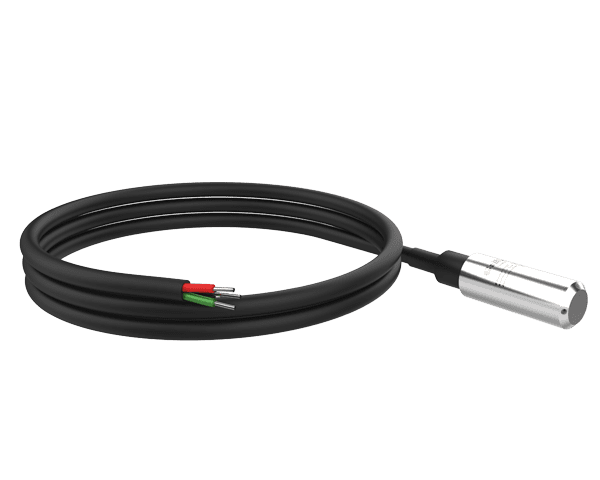
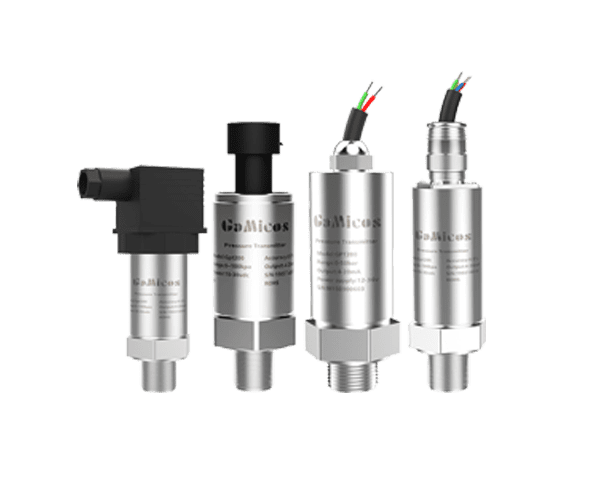
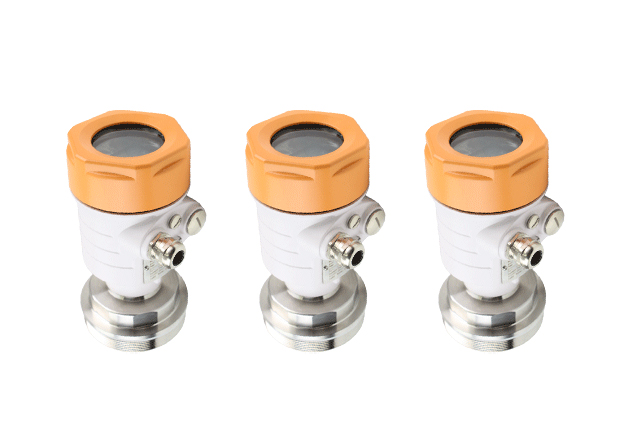
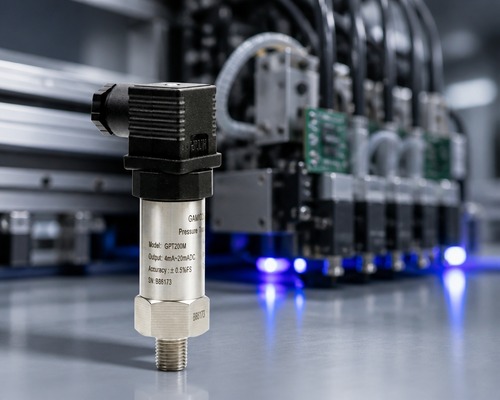
The GPT200 is GAMICOS's general-purpose piezoresistive (diffused silicon) pressure transmitter, covering a range from -0.1 MPa to 100 MPa with support for 10 kPa-class low-range customization. It combines high-resolution capability with industrial-grade reliability and is suitable for pressure monitoring of the ink-supply lines, negative-pressure chambers, circulation systems, and cleaning air circuits of industrial inkjet printers.
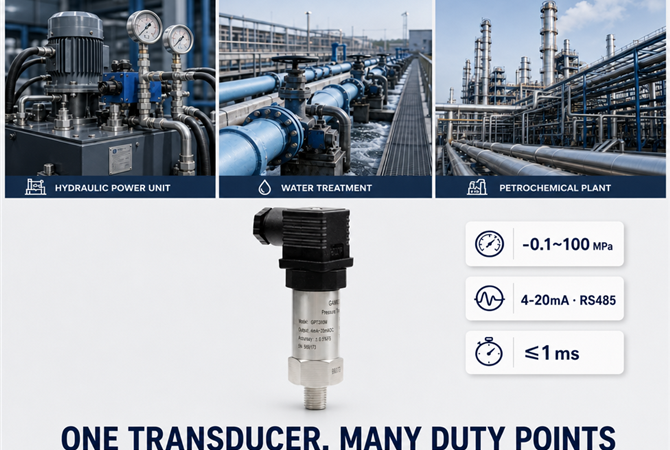
Operating principle: It uses a diffused-silicon piezoresistive sensing element. Medium pressure is transmitted through the 316L stainless-steel isolation diaphragm and a silicone-oil pressure-transfer system to the silicon element, causing its internal Wheatstone bridge to produce an electrical signal change proportional to pressure; after processing by a dedicated amplification and temperature-compensation circuit, it outputs a standard industrial signal. This principle inherently offers high sensitivity and good low-range linearity, making it especially suitable for hectopascal-level micro-pressure measurement.
Core product features
- Low-range customization + 0.25%FS high accuracy: It supports low-range customization such as -10~0 kPa and 0~10 kPa; combined with a 0.25%FS accuracy class, the absolute error can be held to about ±25 Pa, far better than the ±200~300 Pa tolerance required by the process; higher accuracy classes of 0.1%FS and 0.075%FS are also optional. This shifts negative-pressure calibration from trial-and-error spraying to data-based calibration.
- Multiple electrical-signal output formats, directly connectable to closed-loop control: It provides 4-20 mA, 0-5 V, 0-10 V, and 0.5-4.5 V analog outputs as well as RS485 and I2C digital outputs, connecting directly to the printer main control board, PLC, or negative-pressure control module to form a negative-pressure PID closed loop.
- Continuous dynamic response capability; pulsation can be quantitatively recorded: The transmitter outputs continuous analog / high-refresh-rate digital quantities; together with the controller's data logging, the pressure waveform can be reconstructed, turning the amplitude and frequency of diaphragm-pump pulsation into observable, traceable data. This provides clear criteria for damper aging and proportional-valve failure, avoiding blind.
- 316L stainless steel isolation diaphragm, resistant to solvent and UV ink corrosion: The wetted parts use a 316L stainless-steel isolation diaphragm that withstands long-term contact with solvent-based ink, UV ink, and cleaning fluids, suppressing zero-point drift caused by corrosion.
- Liquid-inlet damping structure to resist positive-pressure cleaning shock: The product's liquid-inlet port can be configured with damping to effectively attenuate the impact of instantaneous high pressure on the sensitive diaphragm—this structure has been validated under water-hammer conditions in the customer's irrigation lines and is equally applicable to the pressure shock generated by positive-pressure printhead cleaning.
- IP68 protection and compact structure, adapted for ink carriages and tight internal spaces: The IP68 protection rating prevents damage from ink splashing and cleaning-fluid permeation; the compact structure, together with support for 3.3 V power and a 0.5-2.5 V low-power output mode, facilitates integration into space- and power-constrained locations such as follow-up ink carriages.
- Temperature compensation and long-term stability: A built-in temperature-compensation circuit with a standard operating temperature of -25–85 °C (wide-temperature option available) covers the constant-temperature heating of UV ink (typically 40–45 °C); excellent long-term stability suppresses zero-point drift and reduces the need for periodic calibration.
Key Technical Parameters
| Parameter | Specification |
|---|---|
| Range coverage | -0.1MPa ~ 0-10kPa ~ 100MPa (low-range customization supported) |
| Accuracy class | 0.5%FS / 0.25%FS / 0.1%FS / 0.075%FS |
| Pressure type | Gauge (G) / Absolute (A) / Sealed gauge (S) |
| Output signal | 4-20mA / 0-5V / 0-10V / 0.5-4.5V / RS485 / I²C |
| Supply voltage | 12-30VDC / 3.3-5V low-power option |
| Diaphragm material | 316L stainless steel |
| Operating temperature | -25~85℃ (wide-temperature option available) |
| Protection rating | IP65/IP66/IP68 |
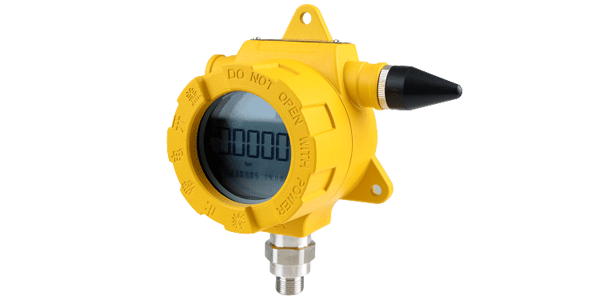
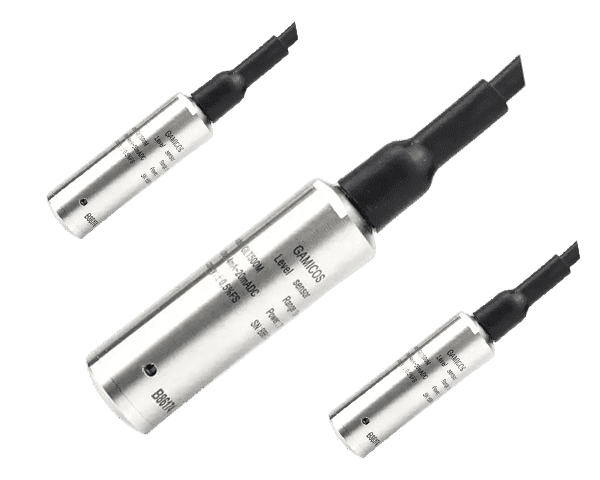
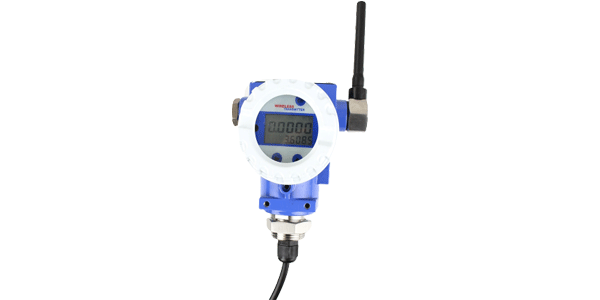
| Electrical connection | Hirschmann / aviation connector / direct lead / liquid-level lead-out / with display |
IV. Customer Application Case
Project background
A European industrial inkjet equipment manufacturer, primarily producing UV roll-to-roll and flatbed hybrid printers, exports complete machines to packaging-printing and advertising-output customers. Its original ink-supply system used a 'mechanical vacuum gauge + open-loop diaphragm pump' scheme: the secondary ink-cartridge negative-pressure value was manually adjusted by assembly technicians based on experience, filter cartridges were replaced on a fixed cycle, and there was no pressure electrical-signal acquisition point inside the machine.
This scheme brought ongoing after-sales pressure: end customers reported regular horizontal streaks in finished prints and occasional white gaps from dropped lines; the proportion of printheads returned for rework due to ink starvation and air-bubble intrusion remained high, and because industrial printheads are expensive, rework and replacement costs directly eroded the whole-machine profit. Meanwhile, negative-pressure calibration of each new machine before shipment required senior technicians to spend several hours, becoming a bottleneck for capacity expansion. The customer therefore decided to digitally retrofit the pressure-monitoring portion of the ink-supply system.
Solution
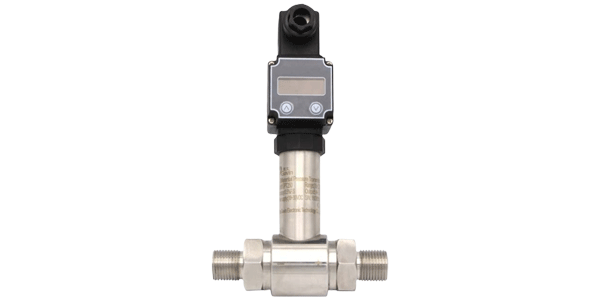
After mapping the customer's ink-supply topology, the GAMICOS technical team identified four categories of critical measurement points and built a pressure-monitoring network centered on the GPT200; for the differential-pressure measurement of filter pressure drop, the integrated GPT250 differential-pressure transmitter is recommended as a companion.
| Mounting location | Recommended model | Range | Accuracy and output | Monitoring purpose |
|---|---|---|---|---|
| Secondary ink-cartridge negative-pressure chamber (one channel per color) | GPT200 | -10-0kPa (custom) | 0.25%FS, RS485 | Meniscus negative-pressure closed-loop control and real-time alarm |
| After the pump on the main ink-supply line | GPT200 | 0~100kPa | 0.25%FS, 4-20mA | Ink-supply pressure stability and pump pulsation waveform logging |
| Filter inlet/outlet | GPT250 | 0~50kPa differential pressure | 0.5%FS, 4-20mA | Filter clogging trend warning and on-demand replacement |
| Cleaning positive-pressure air circuit | GPT200 | 0~100kPa | 0.5%FS, 4-20mA | Controlled positive-pressure cleaning pressure |
2020 in the negative-pressure chamber is connected to the printer main control board via the RS485 (Modbus RTU) bus, forming a PID closed loop with the negative-pressure pump and proportional valve to keep the negative pressure stably at the set value in real time;
- Pipeline and air-circuit measurement points are connected to the equipment PLC via 4-20mA, and the pressure waveform is displayed as a trend curve on the HMI with historical data retained for traceability;
- A three-tier threshold logic is set—slight deviation triggers an HMI prompt, crossing the limit triggers an audible-visual alarm, and severe over-limit interlocks to pause printing and lock the printhead, preventing continued production with a fault;
- When the filter differential pressure reaches a preset threshold, a cartridge-replacement reminder is pushed, realizing 'replacement on demand' rather than 'replacement on schedule';
- Pressure data is uploaded via a gateway to the customer's MES and remote operation-maintenance platform, supporting archiving of factory shipment parameters and remote after-sales diagnostics.
Application results
The retrofit solution was validated on the customer's two complete-machine assembly lines and applied in volume; operational data shows:
- Negative-pressure fluctuation narrowed from ±0.5kPa to ±0.05kPa — The fluctuation amplitude is reduced by about 90% and remains stably within the process-allowed ±0.2-0.3kPa window, keeping the nozzle meniscus stable throughout.
- Print scrap rate reduced from 4.0% to 0.8% — A reduction of up to 80%; regular horizontal streaks and dropped-line white gaps are essentially eliminated, and material waste is significantly reduced.
- Average monthly printhead reworks reduced from 8 units to 2 units — Reduced by 75%; irreversible damage from ink-starved dry spraying and air-bubble intrusion is effectively controlled, and after-sales costs drop substantially.
- Filter consumption cost reduced by 35% — Differential-pressure-data-driven on-demand replacement avoids both the waste of premature replacement and the printhead loss caused by delayed replacement.
- Single-machine negative-pressure commissioning time reduced from 4 hours to 1 hour — Reduced by 75%; calibration shifts from trial-and-error spraying to data-based calibration, can be performed by ordinary assembly workers, and the process parameters achieve standardized replication.
- Payback period approximately 5 months — Based solely on the savings in printhead rework and scrap material costs, the retrofit investment can be recovered within 5 months.
| Comparison item | Before retrofit | After retrofit | Improvement magnitude |
|---|---|---|---|
| Negative-pressure control fluctuation | ±0.5kPa | ±0.05kPa | Narrowed by 90% |
| Print scrap rate | 4.0% | 0.8% | Reduced by 80% |
| Average monthly printhead rework count | 8 units | 2 units | Reduced by 75% |
| Filter consumption cost | Replace by cycle | Replace on demand | Reduced by 35% |
| Single-machine commissioning time | 4 hours | 1 hour | Reduced by 75% |
V. Solution Summary
- Accuracy matched to process tolerance: the GPT200's low-range customization combined with 0.25% FS accuracy compresses the measurement error from the ±500 Pa level to the ±25 Pa level, making the hectopascal-level meniscus negative pressure, for the first time, a precisely measurable and closed-loop-controllable process parameter.
- Shifting from 'post-hoc remediation' to 'preemptive interception': continuous pressure signals feed into closed-loop control and tiered alarms, so that negative-pressure drift, pump pulsation, and filter clogging are identified and addressed before they turn into scrap and printhead damage.
- Protecting high-value printhead assets: targeting the core cost driver of the inkjet industry, dual monitoring of ink-supply pressure and differential pressure significantly reduces the probability of irreversible damage, directly improving the whole-machine lifecycle cost.
- Process reproducibility and traceability: standardized archiving of pressure data frees negative-pressure calibration from dependence on individual experience, supporting equipment manufacturers' capacity expansion and remote after-sales diagnostics.
- Industrial-grade reliability and integration convenience: 316L isolation diaphragm, liquid-inlet damping structure, IP68 protection, and a compact low-power design suit real-world conditions such as solvent/UV ink media, positive-pressure cleaning shocks, and the confined spaces of ink carriages.